Mining safety and environmental management depend on timely field reporting, clear responsibility and visible follow through. MineGuard Ghana is a working portfolio MVP that explores how these activities can be connected in one practical decision support system.
I developed MineGuard Ghana to demonstrate a digital workflow for recording incidents and near misses, monitoring environmental observations, assigning corrective actions, reviewing spatial signals and producing management summaries. The project is Ghana focused, but it is not presented as an approved regulatory system.
The problem MineGuard addresses
Operational information can lose value when it is spread across paper forms, messages, spreadsheets and separate departmental records. A safety report may be captured without a visible action trail. An environmental concern may be known locally but difficult to compare with observations from other locations. Managers may receive totals without seeing where delays, repeated signals or unresolved actions are accumulating.
Ghana's Minerals Commission publishes the Minerals and Mining Health, Safety and Technical Regulations, 2012, L.I. 2182, and describes inspection responsibilities that include compliance monitoring, accident and incident investigation, pollution investigation and recommendations to prevent recurrence. MineGuard does not replace those legal processes. It demonstrates how structured digital records could support internal visibility and review.
The solution
The MVP connects six operational areas: an overview dashboard, a structured report form, environmental monitoring, cases and corrective actions, an aggregated risk map and downloadable reports. An access preview also demonstrates how future role permissions could separate responsibilities.
How the current workflow operates
| Stage | What the user does | What the system provides |
|---|---|---|
| Field capture | Records the date, location, report type, operational area, description and coordinates when available. | A structured record with a generated reference and validation. |
| Priority review | Reviews the submitted evidence and confirms the appropriate response. | An explainable Routine, Review or Priority signal for decision support. |
| Corrective action | Assigns an owner, due date and action status. | A visible trail from Open to In progress and Closed. |
| Spatial review | Opens the risk map to compare submitted reports with coordinates. | Aggregated monitoring points and location summaries without claiming unlawful activity. |
| Management reporting | Selects a reporting period and reviews totals and unresolved items. | A printable summary and CSV download for further analysis. |
What has been built
- Overview dashboard with report, open case, priority review and environmental monitoring indicators
- Structured incident, near miss, hazard, community concern and environmental observation capture
- Optional coordinate capture for location based review
- Environmental observations for water, land, air, waste and rehabilitation areas
- Corrective action assignment, due dates and status tracking
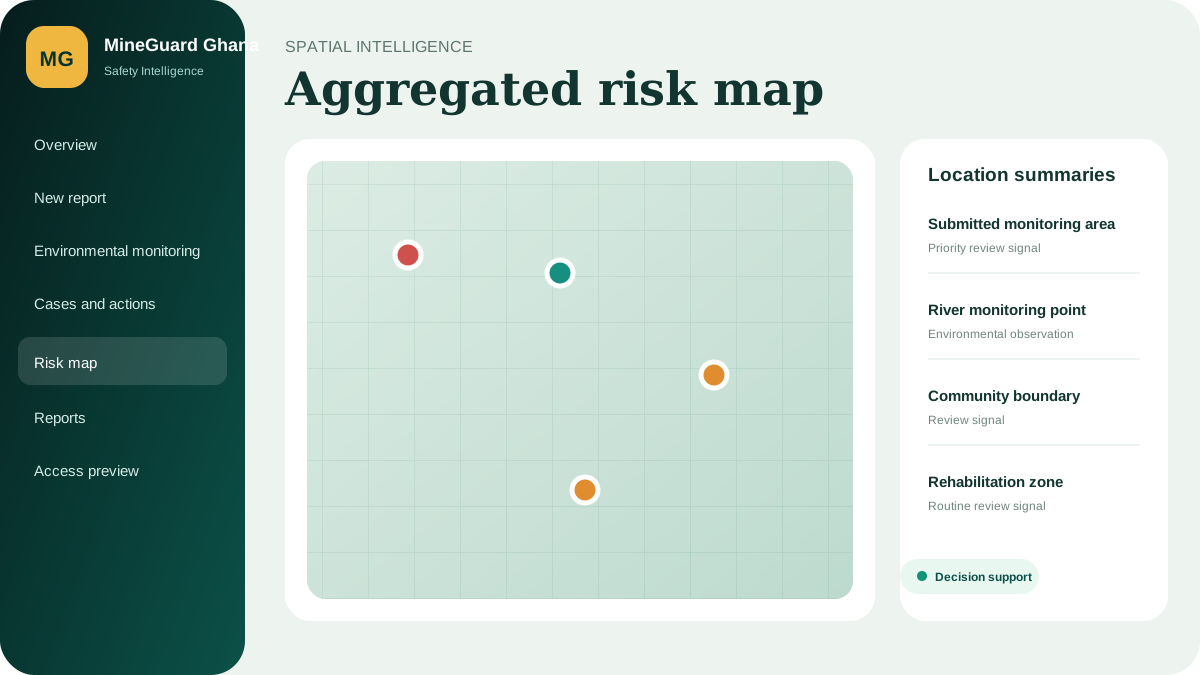
- Aggregated risk map built only from submitted records that contain coordinates
- Location summaries with clear demonstration language
- Monthly management reports, print support and CSV export
- Access preview for eight proposed user roles
- Installable web application foundation for mobile and desktop access
Risk map and spatial responsibility
The risk map was designed carefully. It does not label a location as illegal, unsafe or noncompliant. It plots only reports submitted into the system with coordinates and groups them into operational review signals. The page explicitly states that locations are demonstration monitoring areas, not evidence of unlawful activity.
When no coordinate enabled reports exist, the map displays an honest empty state instead of synthetic points. This protects the credibility of the demonstration and makes the data origin clear.
Explainable decision support
MineGuard does not claim to predict accidents, determine legal responsibility or automate enforcement. The present MVP applies transparent rules to help reviewers organize attention. The source record remains visible, and a qualified person must interpret the evidence and decide the response.
Proposed role based access
The Access preview currently demonstrates eight future roles: Administrator, Occupational Health Officer, Mine Safety Officer, Environmental Officer, Community Relations Officer, Management Viewer, Data Analyst and Regulatory Observer.
This is a presentation layer, not completed authentication. A production system would require secure sign in, least privilege permissions, organization separation, audit logs, account approval, session controls and periodic access review before real operational data could be used.
Technical architecture
Responsive HTML, CSS and JavaScript interface deployed on Render.
FastAPI service providing validation, application logic and REST endpoints.
SQL based storage with a clear path to managed PostgreSQL for persistent production use.
The frontend sends structured records to the backend API. The service validates each request, stores the report and returns shared records to the dashboard, action tracker, map and reporting views. The application contains no preloaded synthetic incident records.
Privacy, security and governance
The current MVP should be used only with demonstration or properly deidentified information. It is not ready for worker health records, confidential company investigations, regulatory evidence or identifiable community complaints.
The project requires an approved data model, privacy impact assessment, threat modelling, managed persistent storage, encrypted transport and backups, access enforcement, complete audit logging, retention rules, incident response procedures and formal legal and operational review.
Why the project matters
The value of MineGuard is not a colourful dashboard. Its value proposition is a traceable line from observation to responsibility. A field report becomes useful when the right person sees it, understands why it matters, records an action and can later demonstrate whether the action was completed.
The ILO Safety and Health in Mines Convention emphasizes mine safety and health governance, while its code of practice for opencast mines includes risk assessment, occupational safety management systems and emergency response principles. WHO guidance also highlights the need for public health strategies around artisanal and small scale gold mining and mercury related risks. These sources reinforce the need for evidence, professional oversight and coordinated systems.
Current MVP boundaries
- No automatic enforcement decision or legal classification
- No diagnosis or individual worker health prediction
- No claim that a mapped point proves illegal activity
- No live connection to government, mining company or laboratory systems
- No completed production authentication or organization isolation
- No validated predictive model
- No authorization for real confidential operational data
Development roadmap
- Expert review: validate reporting fields, priority logic, corrective action pathways and management indicators with safety, environmental, community and mining professionals.
- Secure accounts: implement authentication, enforced permissions, organization boundaries, audit trails and administrator approval.
- Persistent data: connect managed PostgreSQL, backups, recovery controls and data retention policies.
- Operational configuration: allow approved organizations to configure sites, areas, report types, action owners and escalation thresholds.
- Evidence attachments: add secure photo and document upload with consent, metadata controls and retention rules.
- Offline field use: support safe offline capture and controlled synchronization in areas with limited connectivity.
- Interoperability: design reviewed exchange pathways for approved organizational and regulatory systems.
- Evaluation: test usability, completeness, response time, action closure and user trust through a controlled pilot.
Evidence and policy references
- Ghana Minerals Commission: Minerals and Mining Health, Safety and Technical Regulations, 2012, L.I. 2182 ↗
- Ghana Minerals Commission: Inspections and compliance responsibilities ↗
- International Labour Organization: Safety and Health in Mines Convention, 1995 ↗
- International Labour Organization: Code of practice on safety and health in opencast mines ↗
- World Health Organization: Public health strategies for artisanal and small scale gold mining ↗
- World Health Organization: Mercury and health ↗
Explore and contribute
MineGuard Ghana is a working foundation for stakeholder discussion. I welcome review from mine safety professionals, environmental scientists, occupational health practitioners, mining engineers, community relations teams, regulators, data specialists, software engineers, cybersecurity professionals and responsible AI researchers.
Useful contributions include reviewing the reporting fields, improving the decision rules, defining escalation pathways, strengthening privacy and security, assessing usability and helping design a responsible pilot.
Better intelligence begins when every important observation has a clear path to review, responsibility and action.← Back to all insights