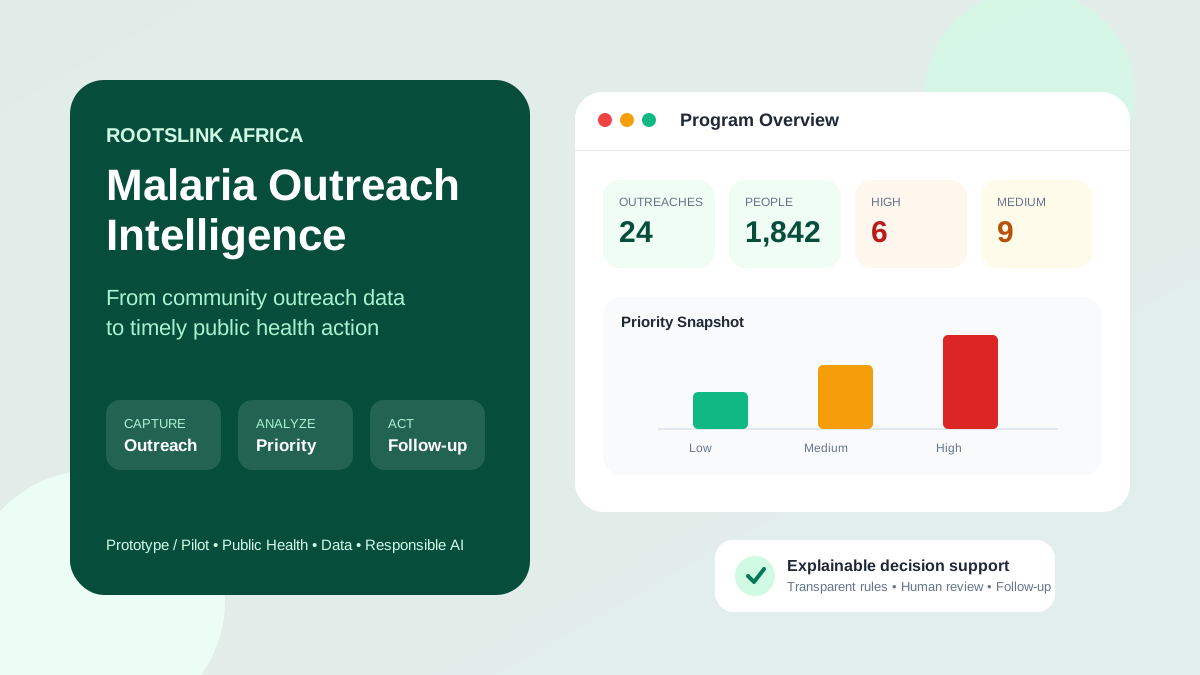
Community malaria outreach generates valuable information about knowledge, prevention practices, misconceptions and treatment behaviours. The challenge is not only collecting that information. It is turning field observations into timely, consistent and practical public health action.
I developed the Rootslink Africa Malaria Outreach Intelligence Platform as a working digital public health prototype to explore how technology, data analytics and responsible AI-style decision support can strengthen malaria outreach monitoring, follow-up and health education.
The public health problem
Community sensitization teams may reach schools, churches, communities and other institutions, but program value depends on more than the number of people reached. Supervisors also need to understand whether key messages were understood, whether insecticide-treated nets are being used, whether harmful beliefs remain, whether people test before treatment, and whether a location needs another visit.
Free-text volunteer notes can contain useful signals such as self-medication, misconceptions, missed antenatal care, net shortages or interrupted education sessions. Without a consistent workflow, those observations can be difficult to review across many outreach activities.
The solution I designed
The prototype combines six connected modules: an Overview dashboard, New Outreach data capture, Follow-up Tracker, MalaGuide field-note analysis, Malaria Q&A, and an Education Center. Together they form a simple workflow from field activity to program action.
From outreach entry to follow-up
The New Outreach form records the date, institution type, community or institution, male and female reach, knowledge score after the session, reported ITN use, belief or myth concerns, test-before-treatment practice and volunteer notes.
When a record is saved, the backend calculates its priority. Low-priority records remain visible on the Overview. High and Medium records are automatically added to the Follow-up Tracker, where supervisors can move an action through Pending, Scheduled and Completed states.
Explainable priority scoring
I deliberately used a transparent rule-based approach for the prototype rather than a black-box prediction. Low knowledge scores, low reported ITN use, harmful beliefs and poor test-before-treatment practice add weighted points. The combined score produces a Low, Medium or High classification.
- Knowledge after session: below 50% receives the highest contribution; 50–69% receives a smaller contribution.
- Reported ITN use: low reported use increases priority.
- Beliefs and myths: stronger harmful misconceptions receive greater weight.
- Testing practice: poor or mixed test-before-treatment behaviour increases priority.
This logic is a pilot decision-support rule, not a validated epidemiological risk model. One purpose of the pilot is to invite epidemiologists and malaria program experts to review the indicators, thresholds and weights before any wider use.
MalaGuide: turning field notes into structured signals
MalaGuide is the prototype's field-note intelligence component. A volunteer can paste a narrative observation and the system looks for configured phrase patterns, spelling-tolerant variants and simple meaning groups. It then structures the observation into an issue category, evidence, related education module, priority contribution, reason, immediate action, longer-term follow-up and supervisor-review flag.
For example, wording that indicates people are buying antimalarial medicine before testing is mapped to the Test Before Treatment education area. Pregnancy-related concerns, dangerous misconceptions, mosquito-net access barriers, incomplete sessions and education-material shortages can also be recognized by the configured rules.
Supporting consistent malaria education
The Education Center provides six core volunteer teaching areas: What Is Malaria, Know the Signs, Sleep Under Mosquito Nets, Test Before Treatment, Protect Pregnant Women, and Keep Your Environment Clean. A separate Q&A assistant provides simple program-aligned educational responses about causes, prevention, symptoms, testing, pregnancy and common beliefs.
The intention is to make the same core guidance easy to access during community engagement while keeping the tool educational rather than diagnostic.
Technical architecture
The project moved from a browser-only prototype to a working full-stack application so outreach records can persist and be shared across devices.
HTML, CSS and JavaScript deployed on GitHub Pages.
FastAPI REST service deployed on Render.
PostgreSQL central prototype database for persistent outreach records.
The browser sends outreach records to the FastAPI backend. The server validates the data, applies the priority rules and stores the record in PostgreSQL. The dashboard then retrieves the shared dataset through the API.
Data protection and prototype boundaries
The application includes a visible data-use notice because the current pilot should contain only non-identifiable program outreach information. Users should not enter names, phone numbers, medical record numbers, individual diagnoses or other personally identifiable health information.
The prototype does not yet include authentication, role-based permissions, audit logging or production-grade governance. Those are requirements for a future production version, not features to hide behind the word AI.
What I learned from building it
The most important lesson has been that useful public health technology begins with the workflow. The question is not simply, “Where can AI be added?” It is, “What decision is difficult today, what information supports that decision, and how can technology make the action clearer without creating new risk?”
That is why the first version emphasizes explainable rules, structured follow-up and human review. More advanced machine learning would only make sense after a clear outcome is defined, sufficient quality data are collected, and the model can be properly evaluated.
What comes next
The next phase is expert review and controlled pilot testing. I want epidemiologists, malaria program specialists and public health practitioners to challenge the design: Are the indicators useful? Are the thresholds defensible? What follow-up actions should be standardized? What data-quality checks are needed? How should the tool be evaluated?
Potential future improvements include authenticated volunteer and supervisor roles, richer analytics, geographic visualization, data-quality flags, exports and reports, offline-friendly data capture, validated Ghana-context language examples for MalaGuide, and approved interoperability pathways with DHIS2 or DHIMS2 where authorization permits.
Try the working prototype
This project has moved beyond a design concept. The deployed prototype can be explored online. Please use only demonstration or non-identifiable outreach data.
Technology becomes valuable in public health when it helps people move from information to a better, safer and more timely decision.
Interested in digital public health innovation?
I welcome technical review, public health feedback and collaboration around responsible technology, health data and decision-support systems.
Contact Me ↗