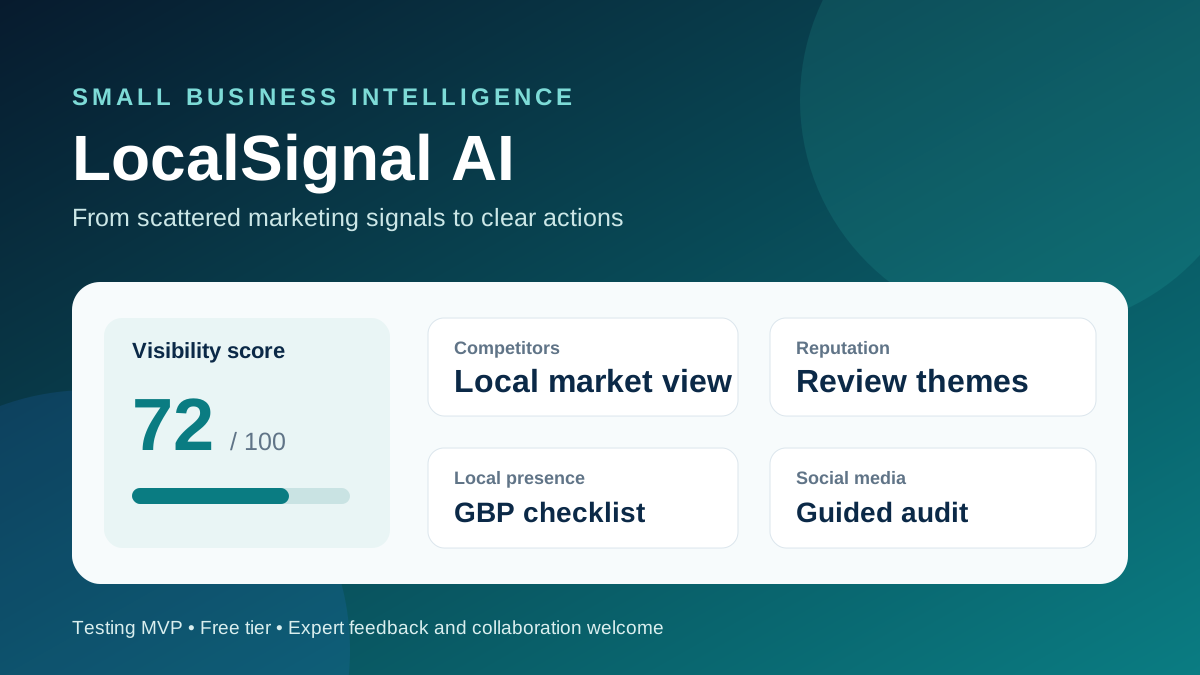
Small businesses and marketing agencies often manage competitor research, local search visibility, customer reviews, website checks and social media activity across separate spreadsheets and platform dashboards. LocalSignal AI explores how these signals can be organized in one workspace and translated into practical actions.
I developed LocalSignal AI as a working minimum viable product for early testing, mentor review and product validation. The current objective is to learn which workflows, scores and recommendations provide genuine value before investing in production infrastructure and external platform integrations.
The business problem
Local marketing decisions are difficult when evidence is scattered. Owners may know that reviews, Google visibility, competitors, website quality and social activity matter, but they may not have a simple way to compare those signals, identify gaps and decide what to improve first.
How the system works
A user creates an account, sets up a business workspace and records relevant competitors, local keywords and customer reviews. The user can then complete website, Google Business Profile and social media assessments. LocalSignal calculates transparent scores, highlights gaps and presents recommended actions for review.
What has been built
- Account registration, sign in and authenticated workspace access
- Business profile and market setup
- Competitor records and comparison information
- Local keyword and ranking tracking
- Customer review records, themes and sentiment
- Guided website, Google Business Profile and social media audits
- Simple scoring and priority recommendations
- An action center for organizing next steps
Important limitation of the social media audit
The social media module is not connected to the Meta API or other social platform APIs. Entering a Facebook or Instagram link does not automatically read the page, posts, reach, engagement, messages or advertising data.
The current module is a guided assessment. The user reviews the actual profile, verifies checklist items and then runs the audit. Approved Meta integration would require a developer application, user authorization, approved permissions, secure OAuth handling and compliance with platform policies.
Google Business Profile assessment
The Google Business Profile module also uses a guided checklist in the current MVP. It assesses areas such as profile verification, business information, categories, services, description, photos, posting activity, review growth, review responses and action links. A production version would require approved Google Business Profile API access and secure authorization.
Technology and deployment
React, TypeScript and Vite.
FastAPI, Python and SQLAlchemy.
Render free tier with GitHub source control.
Free tier testing conditions
The free API may sleep after inactivity, so the first request can take additional time. The current test database and browser saved audit results are not a production data system. Testers should use sample or non sensitive business information only.
Production improvement roadmap
- Move to managed PostgreSQL with backups, recovery controls and reliable data retention
- Add organizations, multiple client workspaces and role based access
- Add email verification, password reset, stronger session controls and audit logs
- Develop evidence based website scanning with clear rate limits
- Apply for approved Google Business Profile and Meta integrations
- Validate audit weights with marketing experts and pilot users
- Add report exports, scheduled summaries and branded client reporting
- Add monitoring, error tracking, testing and separate deployment environments
- Complete privacy, consent, account deletion and data governance controls
Feedback and collaboration
I am inviting software developers, digital marketers, local SEO specialists, product professionals, agencies and small business owners to review the MVP and help shape a credible production version.
- Which three features would create the most value for the first customer?
- Which integration should be developed first?
- How should the audit criteria and scoring be improved?
- What evidence should appear beside every recommendation?
- What safeguards are required before a controlled pilot with real businesses?