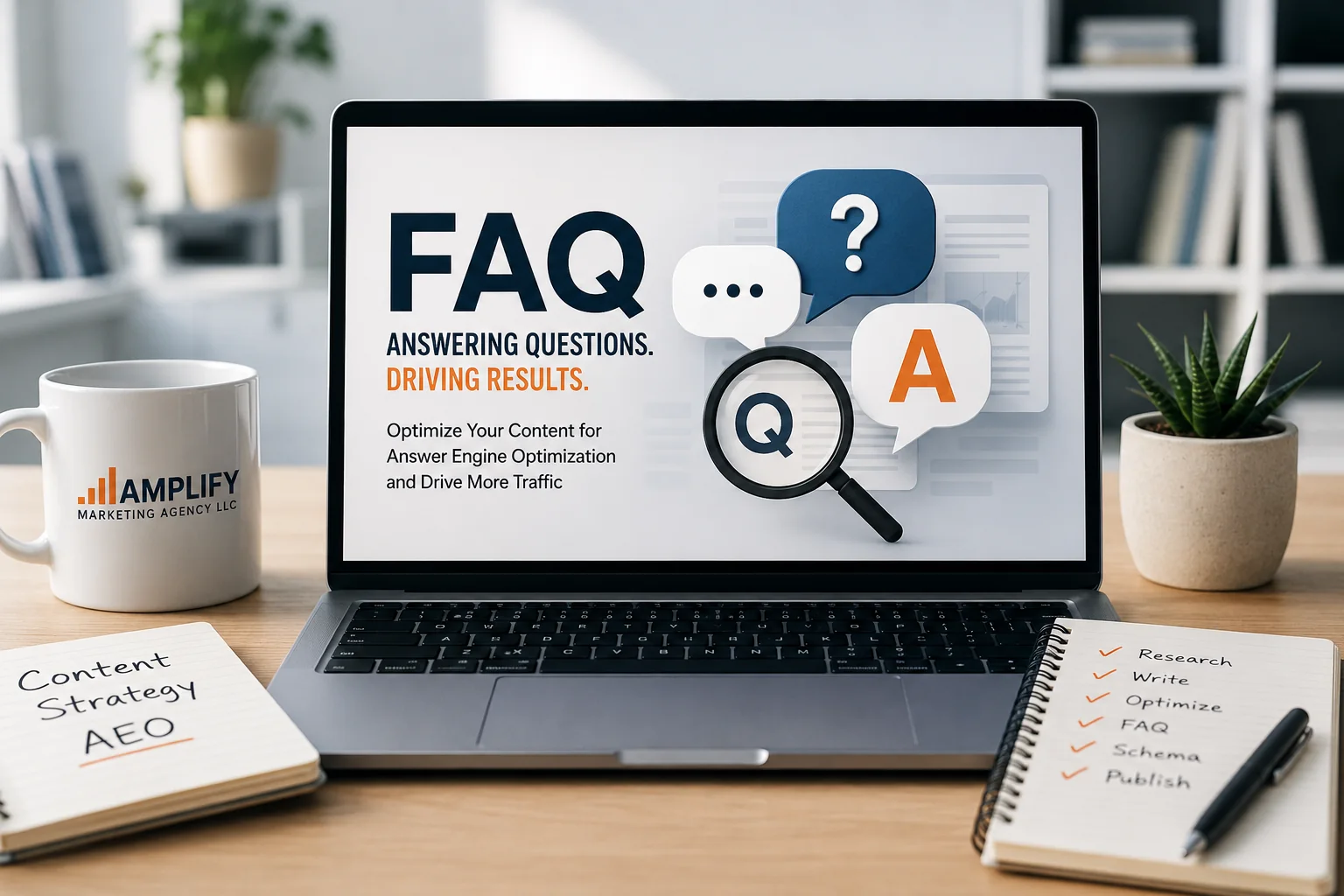
Search engines increasingly return direct answers instead of only presenting a list of webpages. This shift has made Answer Engine Optimization—or AEO—an important part of modern content strategy.
As a digital marketer working across SEO, content strategy and data-driven growth, I often return to one practical question: should every blog post include an FAQ section? The short answer is no. An FAQ section is most valuable when it answers real follow-up questions, strengthens the article and makes information easier for people and machines to interpret.
- How AEO differs from traditional SEO
- When FAQ sections are genuinely useful
- How to write concise, search-informed answers
- How to use structured data responsibly
Understanding AEO and FAQ sections
Traditional SEO aims to make a webpage relevant, accessible and authoritative for a search topic. AEO focuses more specifically on structuring information so that search engines, voice assistants and AI-powered discovery tools can identify a clear answer to a user’s question.
FAQ sections can support that goal because they create an explicit question-and-answer structure. They can also expand long-tail query coverage and help demonstrate that the writer understands the audience’s actual concerns.
Why FAQ sections can support AEO
- Question-and-answer alignment: The format mirrors the way many people search.
- Clear language: Direct answers are easier for readers and automated systems to interpret.
- Long-tail coverage: Relevant questions naturally include variations of a primary topic.
- User-intent clarity: Good FAQs address what readers need to know next.
When FAQ sections are worth adding
Not every article requires an FAQ. I would prioritize one in the following situations.
1. Product or service guides
People evaluating a service usually have questions about process, suitability, limitations and next steps. A focused FAQ can address common concerns before they become barriers.
2. How-to and tutorial content
Step-by-step guides often create follow-up questions: what happens if a step fails, whether an alternative works, or which sequence matters. FAQs can resolve these issues without interrupting the main tutorial.
3. Technical or specialist topics
Complex subjects in digital marketing, public health, data science or technology often require short definitions and clarification. An FAQ can make the article more accessible to readers with different levels of experience.
4. Competitive search topics
For a topic with many related searches, a carefully researched FAQ can expand coverage while keeping the article organized. The additional questions must remain relevant to the primary topic.
5. Content serving different audience segments
An article may serve beginners, practitioners and decision-makers. A short FAQ can address the most important question from each group without making the main narrative unnecessarily long.
FAQ best practices for search and readers
Research genuine questions
Use Google Search Console, customer conversations, sales enquiries, community discussions and keyword-research tools to identify questions people actually ask. Avoid manufacturing questions merely to add more keywords.
Lead with a direct answer
The first sentence should resolve the question. Add explanation only when it provides necessary context. Concision is useful, but there is no universal word count that guarantees a featured snippet or AI citation.
Use natural language
Write questions in the language your audience uses. “What is answer engine optimization?” is clearer and more natural than forcing an awkward keyword phrase into a heading.
Connect readers to deeper information
When an answer relates to a detailed section or another useful article, provide an internal link. This makes the FAQ part of the reading journey rather than an isolated block created only for search engines.
Avoid repetition
If the article already answers a question clearly, repeating the same paragraph in an FAQ adds little value. The section should close information gaps, summarize complex points or answer logical follow-up questions.
Using FAQ structured data responsibly
Schema markup is machine-readable information that describes the content of a page. FAQPage markup uses Question and Answer objects to represent visible FAQs.
Structured data can help Google understand a page, but it does not guarantee a special search appearance. Google’s current guidance also limits FAQ rich-result visibility primarily to authoritative government and health websites. For most personal and business websites, the strongest reason to include FAQs is therefore user value and content clarity—not the promise of a rich result.
{
  "@context": "https://schema.org",
  "@type": "FAQPage",
  "mainEntity": [{
    "@type": "Question",
    "name": "Does every blog post need an FAQ?",
    "acceptedAnswer": {
      "@type": "Answer",
      "text": "No. Add one when it answers genuine follow-up questions."
    }
  }]
}
Any structured data should represent content that is visible on the page. Validate the markup with Google’s Rich Results Test and the Schema Markup Validator. Google also notes that valid structured data does not guarantee a rich result.
Frequently asked questions
Does every blog post need an FAQ section?
No. An FAQ section is useful when readers have predictable follow-up questions that the main article does not answer efficiently. Adding one without a genuine user need can create repetition and clutter.
Can FAQ sections improve AEO?
Yes, when they provide concise, accurate answers to real audience questions. Their value comes from clear question-and-answer structure, stronger intent coverage and better readability—not from the section label alone.
Does FAQ schema guarantee a Google rich result?
No. Structured data can help search engines understand page content, but it does not guarantee a rich result. Google has also limited the visibility of FAQ rich results for most websites.
How long should an FAQ answer be?
The answer should be long enough to resolve the question clearly and briefly. Lead with a direct answer, then add essential context or an internal link when readers need more detail.
Where should an FAQ section appear?
A consolidated FAQ section usually works well near the end of an article, after the main explanation. Individual questions can also appear within relevant sections when that improves the reading experience.
Conclusion: use FAQs strategically
Every blog post does not need an FAQ section. Add one when it improves the reader’s experience, addresses real search intent and gives useful answers that do not fit naturally within the main discussion.
For product guides, tutorials, technical explanations and competitive search topics, a well-researched FAQ can strengthen content coverage. But the section should remain helpful, original and relevant. AEO works best when content is written for people first and structured so machines can understand it clearly.
← Back to all insights